Inside a service-provider network: CE, PE, P, and RR roles
In production now
Subscribe and you'll get it the day it goes live. A new episode every week.
Subscribe on YouTubeAbout this episode
A packet from Blue Corp's Mumbai office to its Chennai office crosses four Ping Telecom routers, but only two of them know Blue Corp exists. In this episode we open up a service-provider network and meet its four router roles: the customer edge (CE), the provider edge (PE), the provider core (P) and the route reflector (RR). You'll see what each one does, what it knows and doesn't know, why the smarts live at the edge, and why the route reflector never touches a customer packet. Part of Ping Academy's free course "IP/MPLS: Zero to Service Provider".
What you'll learn
- Describe the four router roles in a service-provider network (CE, PE, P, RR): where each sits, who owns it, and what job it does.
- Explain why the provider puts the intelligence at the edge (PE) and keeps the core (P) simple, and what each role does and does not need to know.
- Explain the iBGP full-mesh problem with numbers (n × (n − 1) / 2 sessions) and how a route reflector solves it without carrying customer traffic.
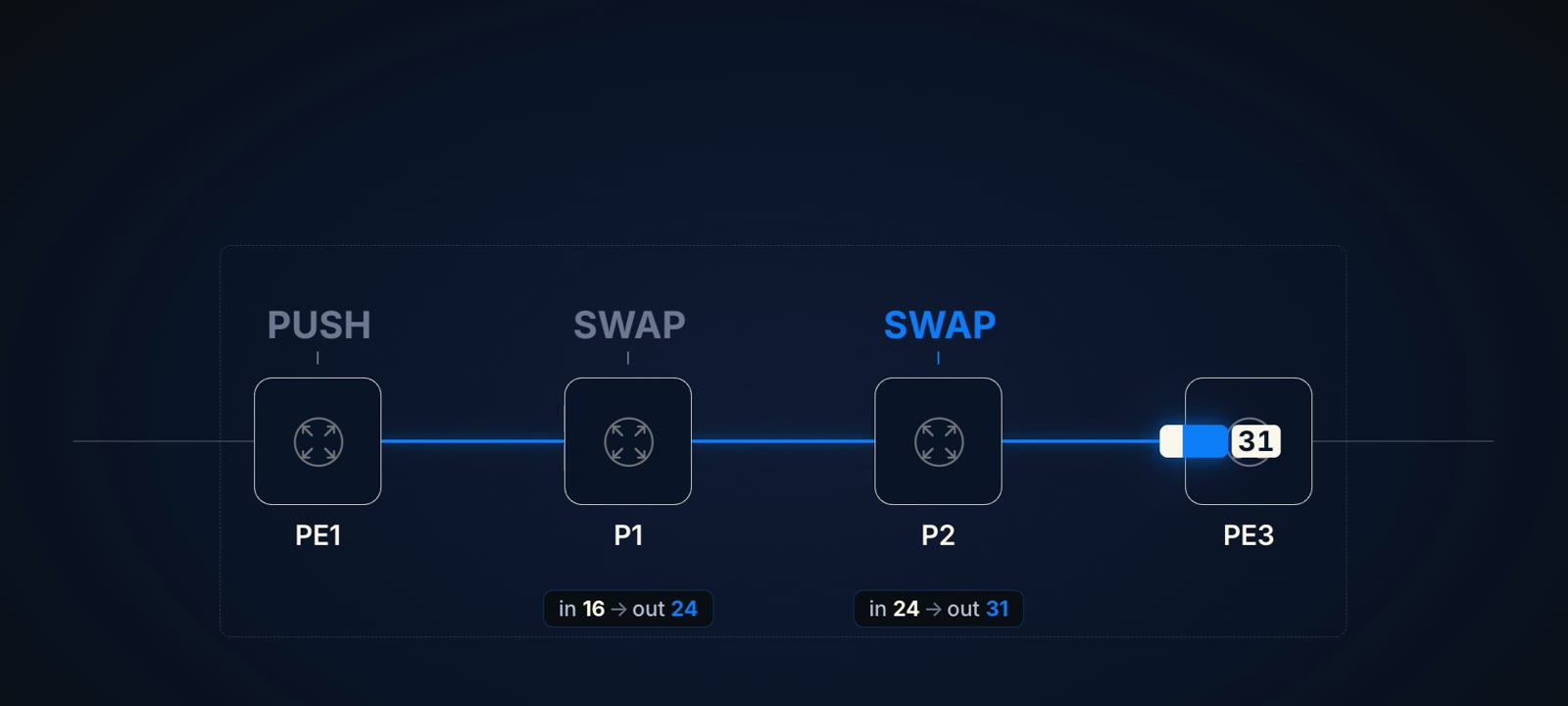
- Follow one packet from CE1 to CE3 across Ping Telecom and say what each router on the path does to it.
- Map the course topology to these roles, and name a few roles real networks add (aggregation, BNG, peering/border routers).
Cheat sheet
- Four roles: CE (customer edge) · PE (provider edge) · P (provider core) · RR (route reflector).
- CE: at the customer's site, usually customer-owned (sometimes provider-managed). Knows its own networks and how to reach its other sites via the PE. The CE–PE link is the demarcation point.
- PE: where customers connect. Keeps separate routes per customer (VRFs, Section 6), does the lookup once and adds labels. Also called LER (label edge router).
- P: core only, never connects to customers. In an MPLS core it needs only provider routes (loopbacks + links: about 23 in our lab), not customer or internet routes. Swaps labels. Also called LSR (label switching router).
- Design rule: think once at the edge, switch fast in the core.
- iBGP full mesh: n × (n − 1) ÷ 2 sessions. 4 PEs = 6, 100 PEs = 4,950.
- RR: each PE peers only with the RR (100 PEs = 100 sessions). The RR reflects routes but is not in the forwarding path. Production networks use 2 RRs; our lab uses 1.
- Watch out: if the RR sits between core routers, a link failure can make it a transit path. Prevent it in the IGP (Section 2).
- Ping Telecom: P1–P4 (core), PE1–PE4 (edge), RR (hangs off P3 and P4), CE1/CE3 = Blue Corp, CE2/CE4 = Red Bank.
- Real networks add: aggregation, BNGs (broadband logins), border/peering routers. A small network may combine roles.