What is IP/MPLS and why every ISP runs it
In production now
Subscribe and you'll get it the day it goes live. A new episode every week.
Subscribe on YouTubeAbout this episode
Most routers inside your ISP never look at your IP address. They read a small number called an MPLS label. In this first episode of IP/MPLS: Zero to Service Provider, you'll see how label switching differs from normal IP routing, what service providers sell with it (internet, L3VPN, L2VPN, traffic engineering), why it still matters alongside Segment Routing, and the full roadmap for building our own ISP, Ping Telecom.
What you'll learn
- Explain the difference between hop-by-hop IP routing and MPLS label switching in one sentence each.
- Name the three problems a service provider has with plain IP routing, and the three things labels make possible (BGP-free core, many services on one network, traffic engineering).
- List the four products a service provider builds on IP/MPLS: internet access/transit, L3VPN, L2VPN, and traffic engineering/protection.
- Explain why MPLS still matters in a Segment Routing world (SR-MPLS reuses the MPLS data plane).
- Recognise the Ping Telecom topology (P, PE, RR, CE) and the order of the course sections.
Cheat sheet
- IP routing = hop-by-hop. Every router does its own longest-prefix-match lookup on the destination IP address.
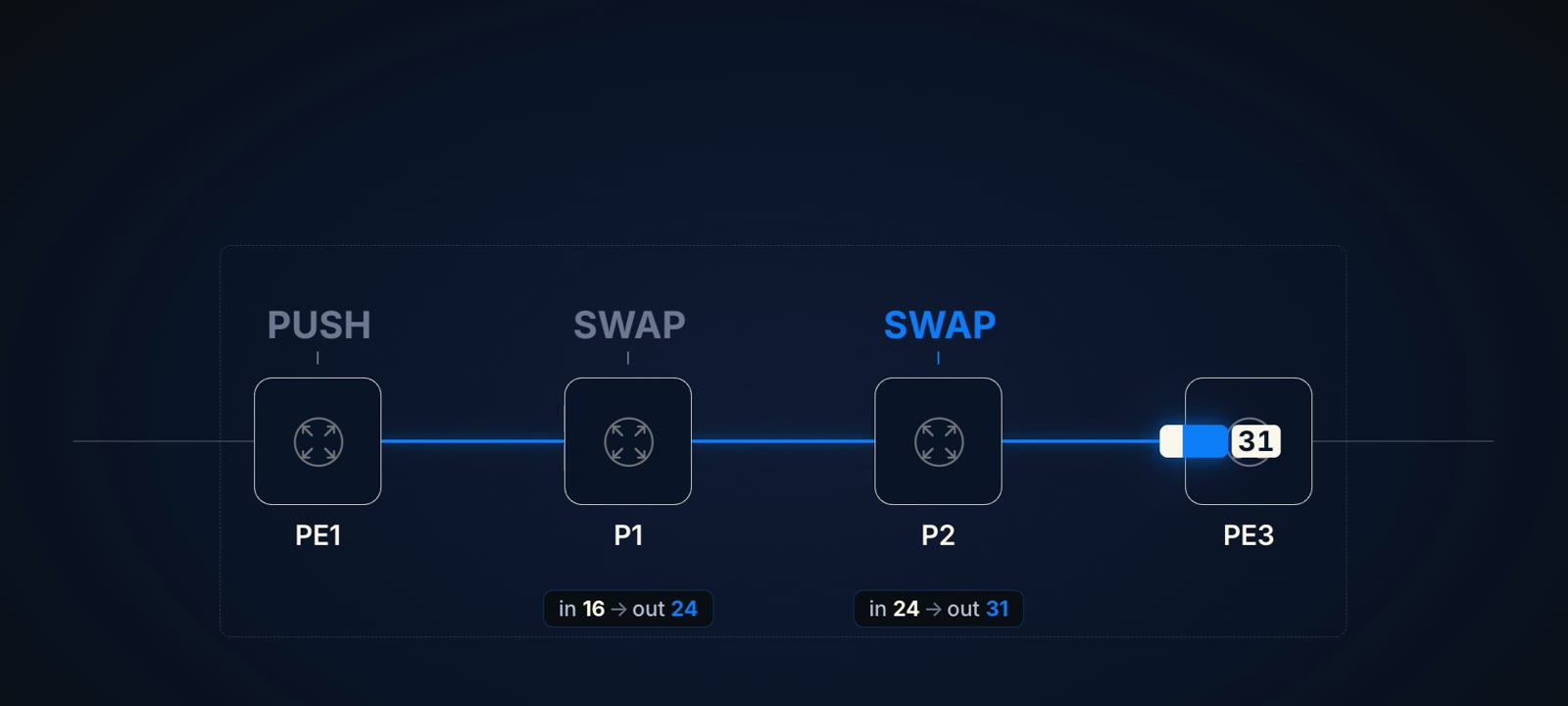
- MPLS = label switching. The ingress PE classifies a packet into a FEC and pushes a label; P routers swap labels with an exact-match lookup; the label is popped at or just before the egress (PHP).
- The label: a 32-bit shim header between Layer 2 and IP, carrying a 20-bit label value (header details in E19).
- LSP = label switched path, the path a labelled packet follows through the network.
- Why ISPs use it: BGP-free core · many isolated services on one network (VPNs) · traffic engineering. Not "because it's faster".
- What ISPs sell on IP/MPLS: internet access/transit · L3VPN (private IP routing per customer) · L2VPN (pseudowires, VPLS, EVPN) · TE and fast reroute (~50 ms).
- Router roles: CE = customer edge · PE = provider edge (services live here) · P = provider core (transit only) · RR = route reflector (BGP distribution).
- Segment Routing: SR-MPLS keeps the MPLS data plane and replaces LDP/RSVP-TE with labels advertised by the IGP. SRv6 uses IPv6 headers instead of labels.
- Ping Telecom: AS 65000 · P1–P4, PE1–PE4, RR · Blue Corp = CE1, CE3 · Red Bank = CE2, CE4.